Our TeamLocationsContact Us859.485.8500
  • Equipment
  • Rentals
  • Brands
  • Parts & Service
  • Financing
  • Media
Contact Us

859.485.8500

Careers

Privacy Policy

What we do

SANY

Morooka Carriers

Paint & Service

Parts

Attachments

Equipment

Rentals

Locations

Verona, Kentucky

Richwood, Kentucky

Saint Clairsville, Ohio

Apopka, Florida

Bartow, Florida

Stay Up To Date

Subscribe to our email list for our Daily Deals and to catch the latest news and best deals in the industry.

© 2026, Newman Tractor, LLC
Loading...
  1. Media
  2. Machine Comparisons

Skid Steer Size Guide: How to Choose the Right Loader for Your Job

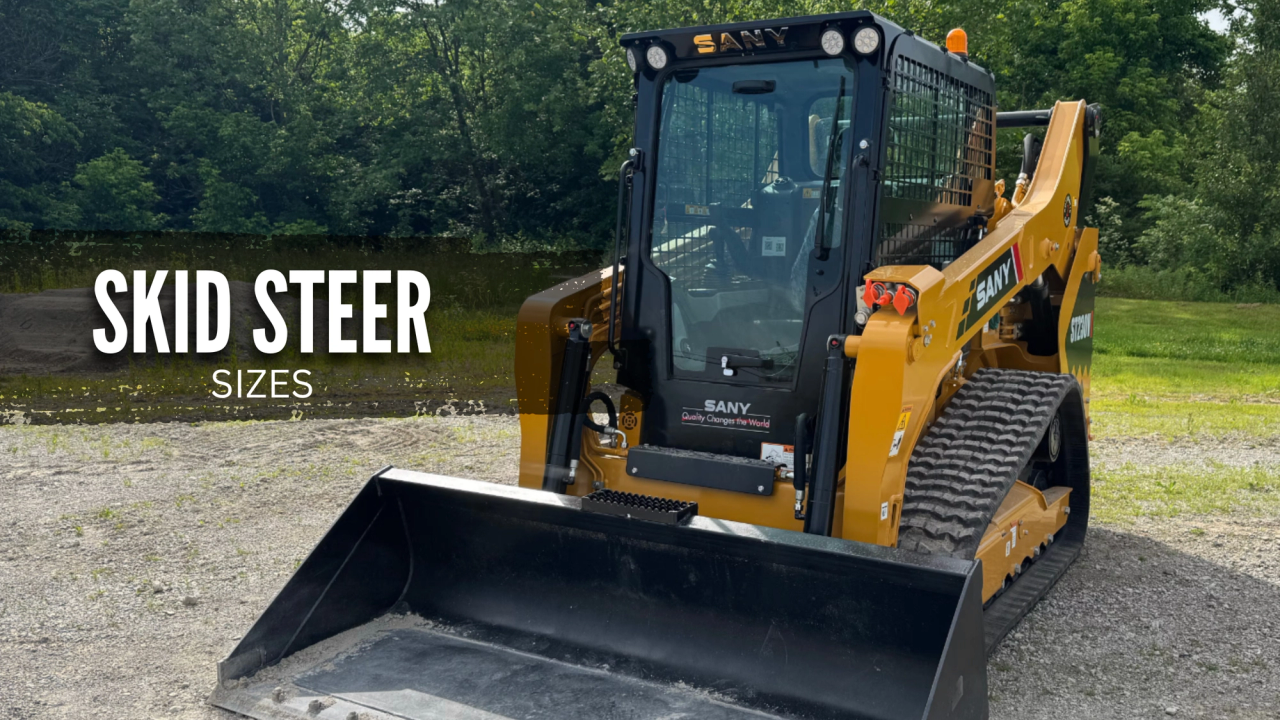
sany skid steer with text reading: skid steer sizes

Skid steers pack a lot of punch into a compact frame, but not every machine fits every task.

Whether you’re clearing brush in a backyard or grading a commercial lot, matching machine size to the job can save time, money, and wear on your equipment.

A Quick Refresher

A skid steer is a rigid‑frame loader with lift arms on each side. What makes them special is their zero‑turn radius (the ability to spin on the spot) combined with a wide range of attachments. Now, let’s focus on how size affects performance, cost, and longevity.

Size Classes and Why They Matter

Manufacturers commonly sort skid steers into several categories based on rated operating capacity (ROC), horsepower, and operating weight. Rated operating capacity (ROC) is the maximum load a skid steer can safely lift and carry at full height, measured at a standard 24-inch load center. For wheeled skid steers, ROC is typically set at 50% of the machine’s tipping load; for compact track loaders (CTLs), it’s usually set at 35%, following ISO standards. As you move up to machines with higher ROC, you gain more horsepower, larger buckets, and the ability to use heavier attachments. However, larger models may sacrifice some maneuverability and come with a higher price tag.

Micro and Mini Loaders (up to 1,200 lb ROC)

These ultra-compact loaders usually weigh between 2,900 and 5,000 pounds and produce 23 to 45 horsepower. Their narrow frames (as little as 36 inches wide) are great for tight yards, indoor work, landscaping, and confined demolition. Tracked mini loaders can pull small stumps or roots while minimizing turf damage, and their size lets them fit through most standard gates.

Compact Loaders (1,200 to 2,000 lb ROC)

With 45 to 65 horsepower and operating weights from about 5,000 to 7,500 pounds, compact skid steers and CTLs balance maneuverability with enough muscle for most residential and light commercial jobs. They’re commonly used for grading, trenching, loading, and pallet handling. Most standard buckets and a range of hydraulic attachments (like augers or breakers) work well within their capacity.

Mid‑Size Loaders (2,000 to 3,000 lb ROC)

These machines deliver 60 to 80 horsepower and weigh 7,000 to 10,000 pounds. They’re the workhorses of general construction, well-suited for moving stockpiles, backfilling trenches, and operating moderate to large attachments, such as mulchers or heavy-duty breakers. On soft ground, their tires or tracks may leave deeper marks, so plan accordingly.

Large Loaders (3,000 to 4,500 lb ROC)

Large skid steers and CTLs offer 75 to 100 horsepower and tip the scales at roughly 9,000 to 12,000 pounds. These machines are designed for demanding tasks, like heavy material handling, demolition, large grading jobs, and forestry attachments. Larger frames mean more hydraulic flow, but also require more space to operate and transport.

Heavy‑Duty Machines (over 4,500 lb ROC)

At the largest end, high-capacity loaders provide up to 110 horsepower and ROC ratings up to ~4,500 pounds, the current industry maximum for skid steers and compact track loaders. These are specialty machines for challenging applications like land clearing, brush cutting, and large-scale site prep. Transporting them requires a heavy-duty trailer, and their size calls for careful planning on tight jobsites.

Specs to Watch

When you compare loaders, these four numbers tell the real story:

  • Operating weight shows how much traction you’ll have and how the machine will compact the ground.
  • Machine width (with and without bucket) determines what gates, doorways, or trailers you can fit through.
  • Rated operating capacity indicates how much weight the lift arms can handle at full height.
  • Bucket breakout force reveals how well the machine digs into tough material.

Keeping the right ratios among these specs ensures you’re not overworking hydraulics or under‑utilizing your loader’s potential.

Matching Size to Your Work

To choose the right class, start by listing your typical jobs:

  • For tight residential yards, indoor demolition, or fence‑row cleanup, a mini or compact loader will zip through without damage to surrounding landscaping.
  • If you’re grading a driveway, moving gravel, or digging trenches on small commercial sites, compact and mid‑size loaders strike the best balance of speed and power.
  • Large‑scale site prep, demolition, or forestry mulching call for mid‑size and large loaders that can smash through tough materials and carry big buckets.

Don’t forget soil conditions. Tracks help any size trudge over mud and soft ground, while wheels deliver faster cycle times on pavement and hardpan.

Popular Models by Class

Here’s a quick look at some well‑known models and where they fit:

ClassModelBrandROCWidth (w/o bucket)
Micro/MiniBobcat S70Bobcat760 lb35.5 in
CompactJohn Deere 314GDeere1,760 lb62.9 in
Mid‑SizeBobcat S650Bobcat2,690 lb72.1 in
Kubota SSV75Kubota2,690 lb69 in
LargeCAT 272DCat3,200 lb76 in
SANY ST230VSANY~3,000 lb72-74 in
SVL-75-3Kubota2,490 lb65.9 in
Heavy‑DutyBobcat T770Bobcat3,475 lb78 in
CAT 299D3Cat3,480 lb80 in

Why Size Impacts Lifespan

Using a mini loader with oversized or demanding attachments can push its hydraulics and undercarriage beyond their design limits, causing higher operating temperatures and accelerated wear. On the flip side, running a large loader for light landscaping or cleanup jobs leads to wasted fuel and increased idle hours, especially with newer emission-controlled engines. Matching your machine size to the job means more efficient operation, better temperature control, less stress on key components, and longer undercarriage life. In the long run, correctly sized equipment is more likely to reach or exceed typical 8,000-10,000-hour service intervals before major overhaul.

Next Steps

Now that you know how size shapes performance, costs, and lifespan, it’s time to find the skid steer that fits your work. Take a look at our full lineup, compare specs side by side, or get in touch with us if you have questions on capacities, widths, or attachments. We’re here to help you choose the right machine and keep it working for years to come.

SKID STEERS FOR SALE


Date: 10.18.2025
Topics: Machine Comparisons
Tags:

Explore More Media

View All Post


Check out our equipment

  • Telehandler vs forklift: which machine is right for your job?
    Telehandler vs forklift: which machine is right for your job?

    If you’re weighing a telehandler vs. a forklift, you’re asking the right question. These two machines can look similar at a glance, but they solve very different problems. Picking … Read More

  • Kubota RTV Service Guide to Keep Your Side-by-Side Running Strong
    Kubota RTV Service Guide to Keep Your Side-by-Side Running Strong

    Is your Kubota RTV due for service? Regular maintenance is what keeps your machine reliable year after year. Here's our complete step-by-step guide to servicing your Kubota RTV so … Read More

Equipment Image
2024 INTERNATIONAL INTERNATIONAL HV607...

EQ10627

Price:
$170,001
Hours:
1174
Equipment Image
2024 KUBOTA KUBOTA SVL97-2HFC SKID...

EQ12064

Price:
$69,000
Hours:
573.04
Equipment Image
2023 KUBOTA KUBOTA RTV-X1140 UTILITY...

EQ10785

Price:
$13,500
Hours:
1121.5
Equipment Image
2019 SANY SANY SY265C EXCAVATOR

EQ1049

Price:
$139,000
Hours:
1564.1
Equipment Image
2006 CAT CAT D6N LGP CRAWLER PIPELAYER

EQ1273

Price:
$65,000
Hours:
5837.03
Equipment Image
2014 JOHN DEERE JOHN DEERE 850K LGP...

EQ2063

Price:
$115,000
Hours:
2304