Our TeamLocationsContact Us859.485.8500
  • Equipment
  • Rentals
  • Brands
  • Parts & Service
  • Financing
  • Media
Contact Us

859.485.8500

Careers

Privacy Policy

What we do

SANY

Morooka Carriers

Paint & Service

Parts

Attachments

Equipment

Rentals

Locations

Verona, Kentucky

Richwood, Kentucky

Saint Clairsville, Ohio

Apopka, Florida

Bartow, Florida

Stay Up To Date

Subscribe to our email list for our Daily Deals and to catch the latest news and best deals in the industry.

© 2026, Newman Tractor, LLC
Loading...
  1. Media
  2. Tips & Tricks

Manual vs. Hydraulic Couplers for Excavators: Understanding the Differences

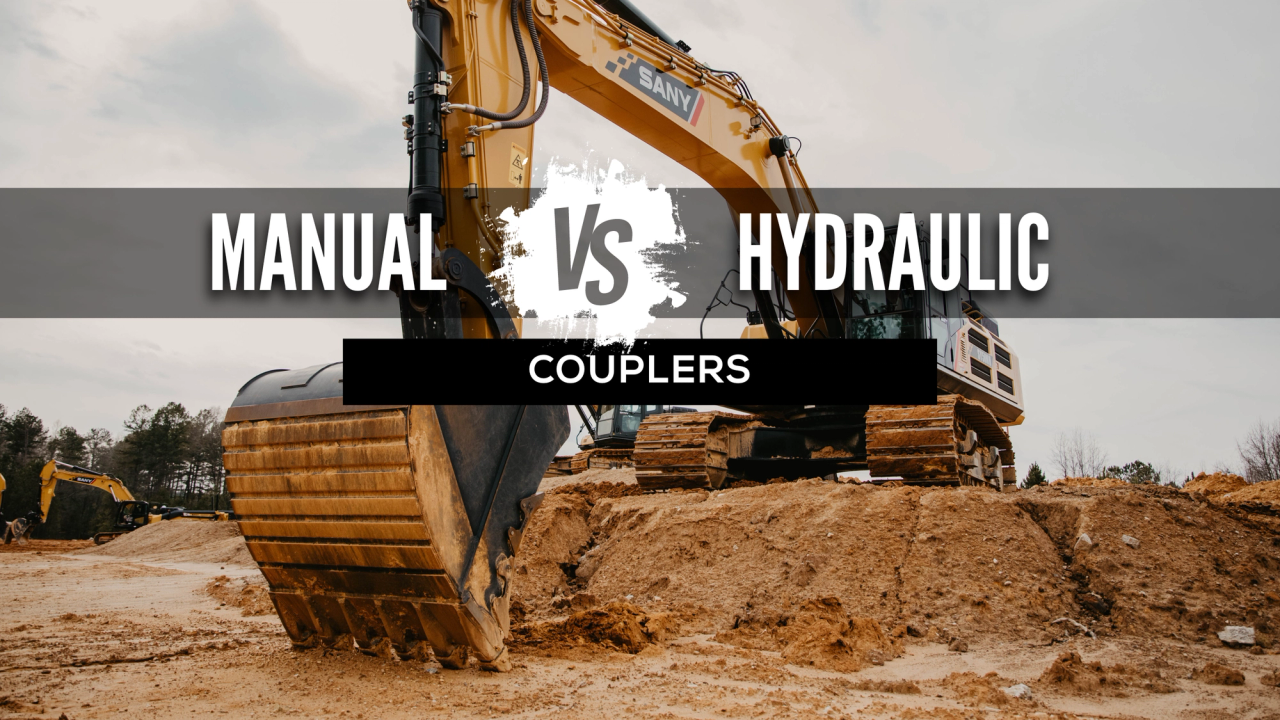
picture of an excavator with manual vs hydraulic couplers written on top

This small but mighty attachment lets you quickly switch between tools, like going from a digging bucket to a mulcher, without breaking a sweat. But when it comes to choosing a coupler, you’ve got two main types to consider: manual and hydraulic.

Manual couplers are all about hands-on changeovers, meaning you'll need to get down and dirty to switch attachments. They’re straightforward and budget-friendly but can slow you down. On the flip side, hydraulic couplers let you swap tools without leaving your seat, making them a real timesaver.

Why does this matter? Because picking the right coupler can make your excavator more versatile and your job easier.

Understanding Couplers

A coupler is a tool that connects the excavator's “arm” to various attachments, like buckets or hammers. Think of it as a quick-change system for your excavator, allowing you to switch from one tool to another without much downtime. This flexibility is crucial, especially when different project stages require different attachments. Are they necessary? Not always, but we rarely see an excavator without one. It’d be like seeing a mechanic with only one wrench.

Using couplers brings several benefits to construction work:

  • Switching attachments quickly means less downtime and more work done in a day.
  • Using a coupler reduces manpower for the task of switching out attachments. Beating out pins takes time.
  • With a coupler, one excavator can do many jobs, from digging to demolishing, by simply changing attachments.
  • Changing attachments with a coupler is safer for operators, as it reduces the risk of manually switching tools.

Manual Couplers

Manual couplers are the traditional type of coupler used in excavators. The origin of the manual coupler isn’t clear, but it looks like it came onto the market in the 1970s by Swedish manufacturer Akerman. They require an operator to manually remove and insert pins to change the attachment. This isn’t the same as beating pins out like you would without a couple, though.

While straightforward, this process requires the operator to leave the cab and physically adjust the coupler and attachment, which can be time-consuming and requires a certain level of skill and safety precautions.

Where They're Used

Manual couplers are often found on smaller excavators where the attachments are lighter and easier to handle. They're suitable for projects where the attachment does not need to be changed frequently, such as specific digging tasks, minor demolition projects, or where the excavator is dedicated to a single type of job for an extended period.

Advantages

  • Manual couplers are simple in design, with fewer moving parts, making them really reliable.
  • They’re generally less expensive than hydraulic couplers, both in initial cost and maintenance.
  • Some operators prefer manual couplers for the control and assurance of physically securing the attachment.
  • The smallest minis can’t run a hydraulic couple without additional plumbing, so a manual coupler is a straightforward solution.

Limitations

  • Changing attachments requires manual labor, which can be strenuous and time-consuming.
  • Manual attachment change can pose safety risks, particularly with heavier attachments or in less-than-ideal weather conditions.
  • Manually changing attachments can increase downtime, especially in projects requiring frequent attachment switches.
  • A coupler adds weight and will change the balance and reduce lift capacity.

Hydraulic Couplers

Hydraulic couplers (sometimes called quick connects, quick couplers, or quick hitches) are a revolutionary 1986 invention that automates changing attachments through hydraulic power. Operators can switch between tools directly from the excavator's cab, pressing a button to release and attach different implements. This system uses the excavator's hydraulic system to operate pins that secure attachments in place, eliminating the need for manual intervention.

Benefits

  • Easily change attachments from the safety and comfort of the cab.
  • Significantly reduces downtime between attachment changes, enhancing productivity.
  • Enables multiple attachments in a single project, making the excavator a more versatile tool.
  • Reduces the risk of injury associated with manual attachment changes.

Ideal Applications

Hydraulic couplers are best suited for projects that require frequent changes between different attachments, such as mixed-use urban development, landscaping, and large-scale construction sites. They are particularly beneficial for mid-sized to large excavators, where the weight and size of attachments can make manual changes impractical or even hazardous.

Considerations

  • Hydraulic couplers are more expensive than manual ones in terms of initial investment and potential maintenance. However, their increased efficiency and reduced downtime often offset this cost.
  • You're paying for a luxury if you’re not changing attachments often.
  • The added complexity of the hydraulic system means there's more that can potentially require maintenance.

Considerations for Small vs. Large Machines

When selecting the right coupler for your excavator, the size of the machine plays a crucial role in determining whether a manual or hydraulic coupler is more appropriate. Each type of coupler has its advantages, but these can vary significantly depending on whether you're working with a small or large excavator.

Small Machines

For smaller excavators, hydraulic couplers might not always be a feasible option. The limitations come from the size of the machine and the hydraulic flow capacity. Smaller excavators may lack the necessary hydraulic power to operate a hydraulic coupler effectively, making manual couplers a more practical choice. While this means operators must physically change attachments, the lighter weight and smaller size of attachments used with compact excavators make manual swaps manageable.

Large Machines

Conversely, manual couplers become increasingly impractical as machine size increases. The primary challenge with large excavators is the sheer size and weight of the attachments. Manually changing a heavy attachment can be a significant physical challenge, requiring multiple people and potentially specialized equipment to ensure safety. Furthermore, the time taken to manually change attachments on large machines introduces considerable downtime, undermining the efficiency of operations. Hydraulic couplers, with their ability to quickly and safely change attachments from the cab, have become almost indispensable for large excavators, greatly enhancing productivity and reducing the physical strain on operators.

Efficiency and Practicality

For large excavators, the efficiency loss associated with manual coupler use is not just a matter of time; it also involves the risk of injury and the logistical challenge of managing heavy attachments. Hydraulic couplers mitigate these issues, offering a seamless and efficient solution that keeps projects moving forward without unnecessary delays.

What size excavators use each coupler?

Here’s a list of SANY excavators and the types of couplers they can use. Some use only manual couplers, others only hydraulic, and some use both. Look at the weights to help you determine what kind of coupler your machine can use if it’s not a SANY (and always check with the manufacturer).

MachineWeight (in pounds)Hydraulic CouplerManual Coupler
SY16C4,023✔
SY26U6,085✔
SY35U8,499✔✔
SY50U11,684✔✔
SY60C13,448✔✔
SY75C16,050✔✔
SY80U19,401✔✔
SY95C20,238✔
SY135C32,783✔
SY155U35,274✔
SY215C51,919✔
SY225C54,013✔
SY265C59,525✔
SY364C80,910✔
SY6500H120,152✔

Choosing the Right Coupler for Your Excavator

The decision between manual and hydraulic couplers is sometimes more straightforward than other times. Here are things to consider when selecting the best coupler for your specific needs:

  • Consider the nature of your projects. A manual coupler should do the job if your work involves repetitive tasks requiring minimal attachment changes. A hydraulic coupler will save time and labor for diverse (or predictably unpredictable) projects demanding frequent switches between attachments. Hello, productivity!
  • Hydraulic couplers are more expensive upfront and may have higher maintenance costs than manual couplers. Manual couplers are a cost-effective choice if budget constraints are tight, provided they meet your project's needs. However, consider the long-term productivity gains and potential cost savings from reduced downtime with hydraulic couplers.
  • And like we said, the size of your excavator can significantly influence the practicality of manual vs. hydraulic couplers. Small excavators can often operate effectively with manual couplers, while large excavators benefit from the ease and safety of hydraulic systems.

Chat with a Professional

Given the complexities of choosing the right coupler, consulting with equipment professionals can provide invaluable insights. These experts can offer personalized advice based on your specific project requirements, budget considerations, and the capabilities of different coupler types. Equipment dealers or rental companies, like Newman Tractor, have the experience and knowledge to guide you through the selection process, ensuring you find a coupler that enhances your excavator's functionality and supports your operational goals.

To make things easy, hit us up on our chat feature, and we’ll walk you through deciding which coupler to use.

Contact Us


Date: 05.13.2024
Topics: Tips & Tricks, Equipment Tutorials
Tags:

Explore More Media

View All Post


Check out our equipment

  • Telehandler vs forklift: which machine is right for your job?
    Telehandler vs forklift: which machine is right for your job?

    If you’re weighing a telehandler vs. a forklift, you’re asking the right question. These two machines can look similar at a glance, but they solve very different problems. Picking … Read More

  • Kubota RTV Service Guide to Keep Your Side-by-Side Running Strong
    Kubota RTV Service Guide to Keep Your Side-by-Side Running Strong

    Is your Kubota RTV due for service? Regular maintenance is what keeps your machine reliable year after year. Here's our complete step-by-step guide to servicing your Kubota RTV so … Read More

Equipment Image
2024 INTERNATIONAL INTERNATIONAL HV607...

EQ10627

Price:
$170,001
Hours:
1174
Equipment Image
2024 KUBOTA KUBOTA SVL97-2HFC SKID...

EQ12064

Price:
$69,000
Hours:
573.04
Equipment Image
2023 KUBOTA KUBOTA RTV-X1140 UTILITY...

EQ10785

Price:
$13,500
Hours:
1121.5
Equipment Image
2019 SANY SANY SY265C EXCAVATOR

EQ1049

Price:
$139,000
Hours:
1564.1
Equipment Image
2006 CAT CAT D6N LGP CRAWLER PIPELAYER

EQ1273

Price:
$65,000
Hours:
5837.03
Equipment Image
2014 JOHN DEERE JOHN DEERE 850K LGP...

EQ2063

Price:
$115,000
Hours:
2304